Hello! I’m an ecologist
I’m fascinated by community connections! I love helping protect and enhance diversity in home or community landscapes to better support native wildlife like bees, butterflies, and birds. I can help inventory plants and other wildlife; develop planting plans, order, install, and maintain wildlife plantings; create picture-books of your wild(er?) neighbors; help develop outreach presentations or other materials for your communities or clients; or pen pieces to help promote protecting or restoring wildlife habitat. I can also share what I understand about wild edible native plants.
Diversity supports healthy communities
I became interested in native plants (especially host plants*) to help people appreciate why biodiversity matters. Hosts* (plant and animal) can help us see the evolutionary connections within a natural community–between native plants, insects, and other wildlife. Trying to understand these connections inspires me to learn as much as I can about the plants and animals whose lives intersect with ours whether we notice or not. I’d love to work with you to better understand and conserve natural communities and to enhance cultivated garden and farm plantings.
*Some animals depend on particular host plants, while others depend on animal hosts. Example host plants are milkweeds that support monarch butterfly caterpillars or spring-beauties that support spring-beauty mining bees. Example host animals are Japanese beetle or June beetle larvae, whose underground foraging on grass roots might be interrupted by a scoliid wasp laying her eggs on them after digging into the earth to find them. The scoliid wasp larvae eat the grubs…though the adult wasp eats nectar and pollen.
Ecological restoration
Sometimes, a little change in management can lead to major benefits for wildlife. Rather than planting, we might help release native seed banks. Many of our natural communities can be restored by removing invasive plants or reintroducing historically natural disturbances that increase canopy openings (using prescribed fire or thinning, mimicing natural fire or tree fall). Before planting in natural communities, consider the existing seed bank.
Trees, shrubs, and herbaceous** plants
To help ensure plantings thrive over time, consider planting densely, with diverse species filling as many ecological and structural niches as possible. An ecological niche might be seasonal bloom–are there lots of flowers every season? Another ecological niche might be overwintering sites–can you leave the leaves, for example, to support creatures who overwinter in leaves? Structural niches include the ground through canopy layers, or evergreen and deciduous species–where do those song birds go when that hawk comes to browse at your feeders?
**Herbaceous plants are annuals and perennials that are not woody, such as wildflowers, grasses, and sedges. Wildflowers are also called forbs (vs. grasses and grasslike plants such as sedges and rushes).
Experience
I have worked for diverse organizations and individuals conducting inventories, monitoring bees, planting wildlife habitat, providing educational materials and programs, and promoting outreach activities. Please see my resume for more details or explore this website to learn more about my work.
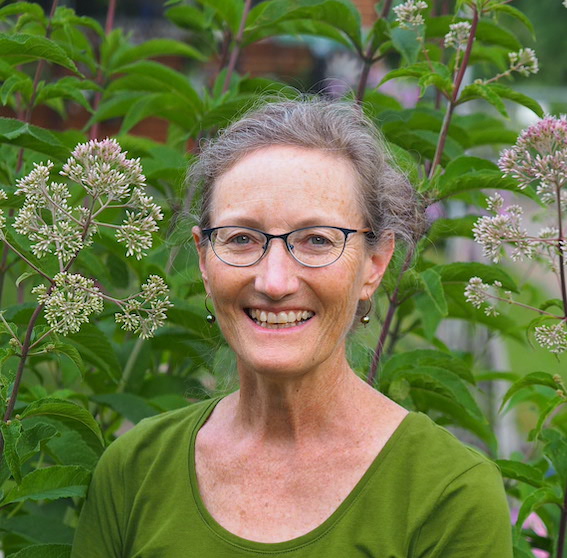
Thanks to Deborah Staves for the photo of me.
 Wild Bee Plantings